(770) 344-0172

(770) 344-0172
Feb 02, 2022
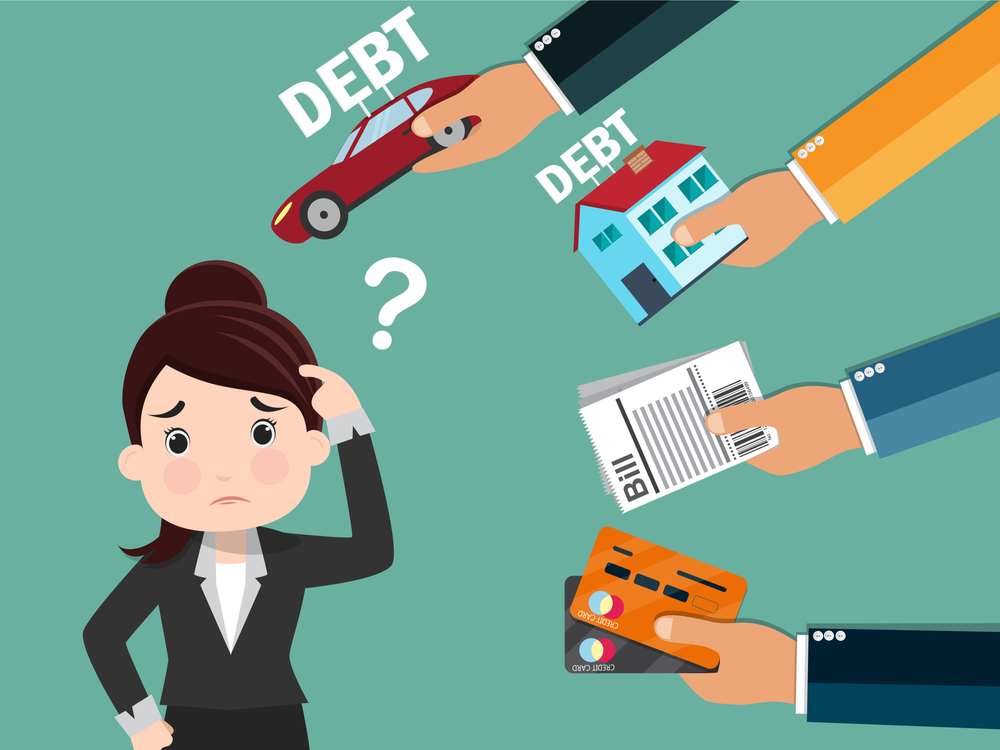
Into: Month two of our year long financial planning series is centered around the topic of debt. What debt is ok to have and what should I avoid? Melissa Visbal answers that and much more in February's addition of Mel's Monthly Money Tips.
Good Debt versus Bad Debt
There are many financial professionals who try to teach consumers that all debt is bad debt. This is simply not true. There might be reasons and experiences that influence your view on debt, but it is misleading to believe that all debt is created equal.
A common measurement for determining if you have too much debt is your debt-to-income ratio. This measurement is commonly used for lending (i.e., determining mortgage capacity), so it can be an essential tool for measuring your debt. For an FHA loan, the “front-end” ratio and the “back-end” ratio are the two numbers used for qualification purposes.
The example above shows a debt position that would be considered “bad” because you are over leveraged on debt.
So, what is considered good debt?
Along with a mortgage that fits your budget, examples of good debt include investing in yourself for education purposes or starting a new business.
Some may argue that the real estate bubble burst in 2008 made Americans temporarily reconsider home ownership as the foundation of wealth. But look what’s happened since the bottom of the Great Recession? Houses are back. According to the Federal Housing Finance Agency, prices have risen 27.5% since 2010. In 2020 alone - in the middle of a pandemic lockdown - home prices surged 10.8%.
Another common debt instrument associated with a home is a Home Equity Loan or Line of Credit. With these debt instruments, borrowers secure a loan using the equity in their home. Some consumers take these types of loans to pay off higher interest debts, such as credit cards. It is also common for borrowers to use the loan proceeds for home improvements in hopes that it could increase the value of their home. Of course, there is risk with these if you don’t make your payments—foreclosure on your home.
Student loans are like mortgages in that both are usually large amounts of money that take a long time to pay back. With a mortgage, you get a house and the value of that house generally increases over time. With student loans, you receive a college education, which can increase your lifetime earning potential. The word “can” is emphasized because the type of education you are buying determines your earning potential. Anything in the so-called STEM fields (science, technology, engineering, and mathematics) have a high earning potential.
Another common type of debt is a one obtained for small businesses. When business owners need money to operate their business day-to-day or to make large purchases, they might need to obtain outside financing for the business. One situation where this is common is with fast growing companies. These companies need increasing amounts of capital put into the company and debt financing is less expensive than equity financing. Another situation in which companies would use debt is for their short-term financing needs, like accounts receivable and inventory.
What is considered a bad debt?
If it loses value the moment you take ownership, it’s usually considered bad debt. A common argument associated with this is automobile loans. With the current low interest rate environment, having a car loan isn’t necessarily a bad thing.
Another type of bad debt are credit cards. This is simply due to the high interest rates associated with credit cards. If you can pay off your card every month, no worries; if you’re carrying a balance every month and paying interest, you need to reconsider your debt management plan.
One thing that every advisor and planner can agree on for their clients is to stay away from payday loans! Typically, borrowers obtain these to receive short-term cash to get through a crisis. In return, you post-date a check, hoping you can pay off the balance when your next paycheck arrives. They’re quick and easy, but the finance charges are outstanding.
If you need a rule of thumb when evaluating your debt options, consider this quote from a principal attorney of a law group, “good debt returns money to your pocket, but bad debt takes money from your pocket.”
https://www.debt.org/advice/good-vs-bad/
https://www.debt.com/student-loan-debt/why-student-loans-are-good/
https://www.uschamber.com/co/run/finance/good-vs-bad-debt-for-small-business
https://www.thebalancesmb.com/debt-financing-pros-and-cons-1200981

Financial Planning Associate
Melissa joined Narwhal in 2018 after completing her master’s degree in financial planning from the University of Georgia, where she also earned her bachelor’s in consumer economics. Her interest in the field began with a curiosity about how people make money decisions—and the emotions behind them. She earned her CFP® certification in 2021 and takes a financial therapy-informed approach to help clients find clarity, confidence, and direction in their financial lives.Melissa lives in Smyrna with her husband, Matt, their baby boy Emmett, and two dogs, Remi and Neely. Outside of work, she enjoys hiking and traveling with her family, practicing yoga, and soaking up slow moments at home.
At Narwhal Capital Management, you’re more than just a portfolio, and it’s not all about the numbers. Let’s start with a meeting about your needs and future goals.